
How to write dish descriptions that make customers hungry
How to write restaurant menu descriptions that increase sales — sensory language, the right length, proven formulas, and the words to avoid completely.
How to Write Dish Descriptions That Make Customers Hungry
"Grilled chicken with vegetables." Technically accurate. Completely forgettable.
"Charred lemon-thyme chicken, hand-carved over crisp roasted seasonal vegetables." Same dish. Same kitchen. Same price. But one of these descriptions makes a guest hungry, and the other makes them move on to the next item.
This is not a stylistic preference — it is measurable. Cornell University researcher Brian Wansink found that using descriptive words for menu labels increased sales by as much as 27%. A separate Cornell study found that renaming basic menu items with more descriptive language increased sales by 28% and made diners willing to pay 12% more for the exact same dish. The words on your menu are not decoration. They are a sales mechanism, and most restaurants leave significant revenue on the table by under-using them.
This guide gives you a repeatable formula for writing descriptions that sell, the specific vocabulary that works, the words that actively hurt sales, and the length and structure that perform best on a digital menu specifically.
Why descriptions matter more than most restaurants think
The mechanism behind this is well documented in hospitality research. Wansink et al. (2001) showed that menus using rich, sensory language led to more favorable evaluations and increased sales, and McCall and Lynn (2008) found that descriptive language in menus increased perceptions of food quality and led to a higher willingness to purchase. Hostinger
The psychological process is straightforward: a description that activates sensory imagination — taste, texture, sound, aroma — creates a mental simulation of eating the dish before the guest has ordered it. That simulation generates anticipation, and anticipation drives the decision to order. A flat, functional description ("chicken with vegetables") gives the brain nothing to simulate. The guest evaluates the dish purely on the words "chicken" and "vegetables" — generic, unremarkable, and easily compared on price alone with every other chicken dish on every other menu they've seen.
A 2024 study published in the International Journal of Hospitality Management used choice-based conjoint analysis to measure the influence of menu description categories — cooking method, sensory language, healthy framing — on consumer choice, confirming that specific description attributes carry measurable weight in purchase decisions.
This matters even more on a digital menu than on a printed one. A guest scrolling a phone screen reads faster and more selectively than someone holding a physical card. Your words have less time to work — which means they need to work harder per word.
The four-part description formula
Rather than starting from a blank page for every dish, use this structure. It works across cuisines, price points, and restaurant formats, and it produces consistent quality without requiring a professional copywriter for every item.
Part 1 — The preparation or cooking method. Lead with how the dish was made: seared, slow-braised, hand-rolled, wood-fired, charred. This signals craft and effort before the guest has read anything else.
Part 2 — The hero ingredient. Name the ingredient that defines the dish, with a quality marker if relevant: wild-caught salmon, grass-fed beef, heirloom tomatoes. Origin and quality markers position dietary or sourcing facts as a feature, not a footnote — "naturally vegan, gluten-free treat" reads as a benefit, not a restriction.
Part 3 — One sensory or textural detail. A single, specific sensory word that helps the guest imagine the eating experience: crispy, velvety, smoky, tangy. One well-chosen word outperforms three generic ones.
Part 4 — The finishing element or pairing. What completes the dish: a sauce, a side, a garnish. This closes the mental picture and often signals additional value.
Applied example:
Component | Content |
|---|---|
Cooking method | Slow-braised |
Hero ingredient | New Zealand lamb shoulder |
Sensory detail | Falling-apart tender |
Finishing element | In a bold red wine reduction |
Full description | "Slow-braised New Zealand lamb shoulder, falling-apart tender, in a bold red wine reduction." |
"Grass-fed New Zealand lamb, slow-braised for 8 hours in a bold red wine reduction" commands a higher price point than the same dish described simply as "Braised lamb." The formula is not decoration for its own sake — it is the mechanism that justifies premium pricing with specificity rather than adjectives.
The vocabulary that actually works — organised by sensory category
Generic adjectives ("delicious," "tasty," "amazing") provide no information and trigger no imagination. Specific sensory words do both. Generic words to avoid are "delicious," "tasty," "good," and "nice" — they don't provide useful information and waste valuable space.
Category | Effective words | What they signal |
|---|---|---|
Texture | Crispy, crunchy, tender, flaky, creamy, velvety, silky, melt-in-your-mouth | Mouthfeel — the physical sensation of eating |
Flavour | Savoury, tangy, zesty, bold, smoky, caramelised, bright, aromatic | Taste profile — what the palate will experience |
Cooking method | Hand-rolled, slow-roasted, fire-grilled, house-made, wood-fired, braised, seared, charred | Craft and process — implies skill and time invested |
Origin and sourcing | Farm-fresh, locally sourced, seasonal, grass-fed, wild-caught, artisanal | Quality and provenance — builds trust and justifies price |
Sound and sensation | Sizzling, crackling, served on a sizzling cast-iron plate | Multisensory anticipation — engages more than taste alone |
"Crispy" evokes a satisfying texture. These descriptive adjectives work because they trigger specific memories and expectations. The skill is not using as many of these words as possible — it's choosing the one or two that are most accurate and most evocative for each specific dish.
The words and phrases to remove from your menu immediately
Some words are doing active damage to your descriptions, either because they're meaningless or because they trigger negative associations.
Meaningless filler words. "Delicious," "tasty," "yummy," "amazing" — these communicate enthusiasm without information. Every dish on every menu could claim to be "delicious." The word does nothing to differentiate yours.
Words that signal negative health connotations. Burnt, fatty, sugary — these adjectives may sound technically accurate, but they make guests feel guilty about indulging, even in a dessert context. Dining should always be a positive experience. "Charred" works where "burnt" doesn't — same cooking reality, opposite emotional response.
Overwrought, poetic language. While well-chosen adjectives can elevate simple ingredients, moderation is key — focus on specific, evocative words rather than over-the-top flourishes. The goal is to stir the senses, not write poetry. A description that reads like a wine review for a burger creates dissonance, not appetite.
Vague mood words with no sensory content. Words like "wonderful" or "incredible" tell customers how to feel without giving them anything specific to imagine. Use words that hint at textures, cooking methods, or flavour notes instead.
The words and phrases to remove from your menu immediately
Some words are doing active damage to your descriptions, either because they're meaningless or because they trigger negative associations.
Meaningless filler words. "Delicious," "tasty," "yummy," "amazing" — these communicate enthusiasm without information. Every dish on every menu could claim to be "delicious." The word does nothing to differentiate yours.
Words that signal negative health connotations. Burnt, fatty, sugary — these adjectives may sound technically accurate, but they make guests feel guilty about indulging, even in a dessert context. Dining should always be a positive experience. "Charred" works where "burnt" doesn't — same cooking reality, opposite emotional response.
Overwrought, poetic language. While well-chosen adjectives can elevate simple ingredients, moderation is key — focus on specific, evocative words rather than over-the-top flourishes. The goal is to stir the senses, not write poetry. A description that reads like a wine review for a burger creates dissonance, not appetite.
Vague mood words with no sensory content. Words like "wonderful" or "incredible" tell customers how to feel without giving them anything specific to imagine. Use words that hint at textures, cooking methods, or flavour notes instead.
The right length for a digital menu specifically
Length is where digital menus diverge most clearly from printed ones, and where most restaurants default to either too little or too much.
The key to excellent menu writing is to keep food descriptions fairly concise — ideally 140 to 260 characters. In terms of word count, keep descriptions between 20 and 30 words for optimal impact.
On a phone screen specifically, this constraint matters more than on a printed page. Shorter menu item descriptions are more likely to be read, especially on mobile screens — the vast majority of guests will be reading your menu on their phones. Avoid walls of text and use line breaks or spacing to help key details pop.
Practical length guide by restaurant context:
Restaurant context | Recommended description length | Reasoning |
|---|---|---|
Fast casual / café | 8–15 words (60–100 characters) | Speed of decision matters most |
Casual dining | 15–25 words (100–180 characters) | Balance of information and scan speed |
Full service / bistro | 20–30 words (140–260 characters) | Room for sourcing and method detail |
Fine dining | 25–40 words (180–300 characters) | Storytelling and provenance carry weight |
Suggested chart type: bar chart comparing recommended description length by restaurant format
The rule that applies regardless of format: if a description requires more than two sentences, it has stopped selling and started explaining. Cut it.
How to write dietary and allergen information without it reading like a warning
Most restaurants treat dietary information as a disclaimer appended after the description, often in brackets: "(V, GF)." This is functional but misses an opportunity.
Try to position dietary restrictions as a "feature" and not a "label." "Light and satisfying quinoa tabbouleh – protein-packed and gluten-free, perfect for clean eating" broadens appeal while keeping customers aware of their choices.
The technique: integrate the dietary fact into the sensory description rather than isolating it as a separate tag. "Naturally vegan coconut chia pudding with fresh berries" reads as an appealing dish that happens to be vegan — not a vegan dish that you're settling for. The dietary fact becomes part of the appeal rather than a constraint on it.
This doesn't replace clear allergen badges — those remain essential for safety and should stay visible and unambiguous. It's specifically about how the description itself frames dietary attributes, separate from the formal allergen labelling.
Matching your tone to your restaurant's identity
Your menu must reflect your restaurant's vibe — whether you're a high-functioning QSR, a poised fine-dining room, or a chill café, the language should say exactly that. A formula gives you structure; tone gives you brand consistency.
Restaurant identity | Tone example |
|---|---|
Casual and fun | "A burger so juicy, you might need extra napkins." |
Upscale and elegant | "Tender filet mignon, seared to perfection, with a red wine demi-glace." |
Rustic and comforting | "Just like Nonna made — hand-rolled gnocchi in a rich, slow-cooked tomato ragu." |
Modern fusion | "Charred bulgogi beef, kimchi slaw, gochujang aioli, grilled corn tortilla." |
Tailor your tone to match your restaurant's brand — consistency builds trust and connection. Pick one register and apply it across your entire menu. A menu that shifts between playful and formal language item to item feels inconsistent, even if each individual description is well written.
Three real examples, before and after
Before: "Pasta with mushrooms and cream sauce."
After: "Hand-rolled tagliatelle in a velvety wild mushroom cream sauce, finished with aged Parmesan."
Why it works: cooking method (hand-rolled), sensory texture (velvety), specific ingredient (wild mushroom, aged Parmesan).
Before: "Grilled salmon with vegetables."
After: "Flame-grilled wild salmon, charred to a smoky finish, served with crisp seasonal vegetables and a zesty lemon butter."
Why it works: specific cooking method, sourcing detail, sensory contrast between smoky char and bright citrus.
Before: "Chocolate cake."
After: "Warm, gooey dark chocolate fondant with a molten centre, served with a scoop of vanilla bean ice cream."
Why it works: temperature detail (warm), texture contrast (gooey vs. molten centre), a specific accompaniment that completes the picture.
How this connects to your digital menu
On a printed menu, a weak description is a static mistake — wrong until the next reprint. On a digital menu, it's an immediately fixable one. This is one of the most underused advantages of switching to digital: you can test a description, watch how the item performs over two weeks, and rewrite it in under a minute if it's underperforming.
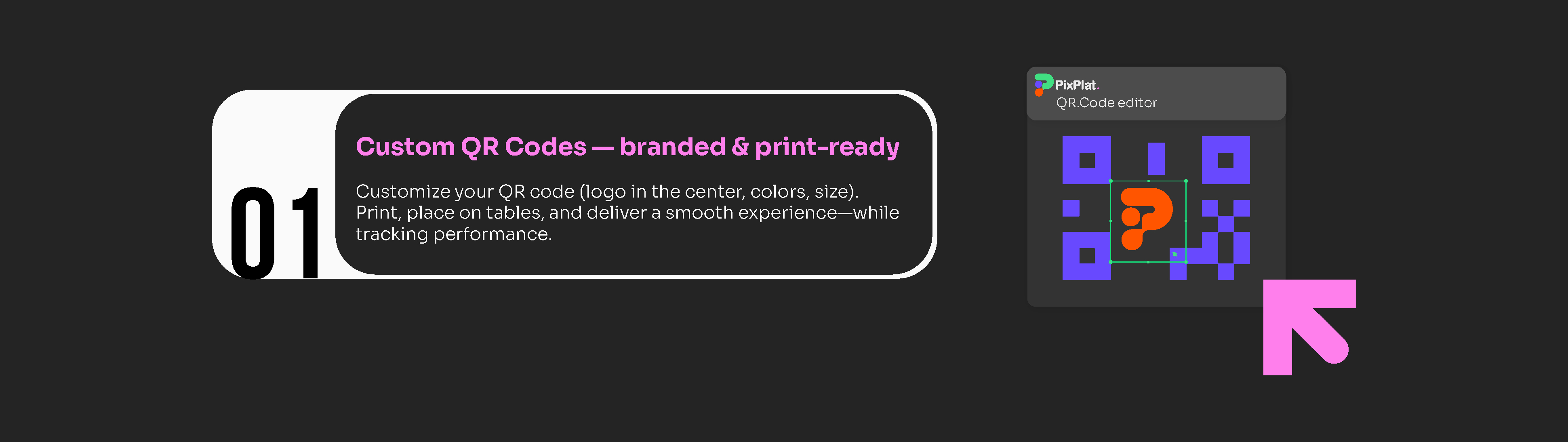
On PixPlat, item descriptions are edited directly in the menu builder with a live mobile preview — you see exactly how the description reads on a phone screen as you write it, including how it wraps and where it might run long. This makes it easy to apply the length guidelines above precisely, rather than guessing how text will render once published.
→ For the complete guide to building your digital menu, see How to create an online restaurant menu: step-by-step
→ For how to structure your categories so the right dishes get read first, see How to structure your menu categories to increase restaurant sales
→ For the full digital menu strategy, see The complete guide to digital menus for restaurants
Frequently asked questions
Do menu descriptions really increase sales, or is this overstated?
The effect is well documented in academic hospitality research, not just industry blog claims. Cornell University's Brian Wansink found descriptive menu labels increased sales by up to 27%, and a separate Cornell study found descriptive renaming increased sales by 28% and willingness to pay by 12% for the identical dish. The effect is consistent enough across studies to treat as a reliable lever, not a marginal tactic.
How long should a menu description be?
140 to 260 characters is the generally recommended range, which corresponds to roughly 20–30 words for most dishes. Fast casual and café contexts should aim shorter (60–100 characters); fine dining can extend slightly longer to support storytelling. The constraint that matters most: if a guest has to read more than two sentences to understand what they're ordering, the description has gone too long.
Should every dish have a long, detailed description?
No. Apply more description length and sensory detail to your highest-margin and signature items — the dishes you most want guests to choose. Simple, familiar items (a side of fries, a basic side salad) need only a clear, short label. Over-describing every single item creates visual clutter and dilutes the impact of the descriptions that matter most.
What's the biggest mistake restaurants make when writing menu descriptions?
Using meaningless adjectives instead of specific, sensory ones. "Delicious," "tasty," and "good" provide no useful information and waste valuable space — every restaurant's menu could claim the same words. The fix is concrete: name the cooking method, the hero ingredient, and one specific sensory detail. Specificity sells; enthusiasm without detail doesn't.